Take-home pay calculator
Type your pay and how often you're paid to get the breakdown on your payslip, and your take-home. Add the rest of your payslip under More options, and your figures to date under Match my payslip.
- It covers one job. Directors' National Insurance, which is worked out over the year, isn't covered.
- Payroll rounds taxable pay down to the pound and catches up over the year, so one payslip can differ from the next by a few pence. Some years have 53 weekly payslips, which this doesn't cover.
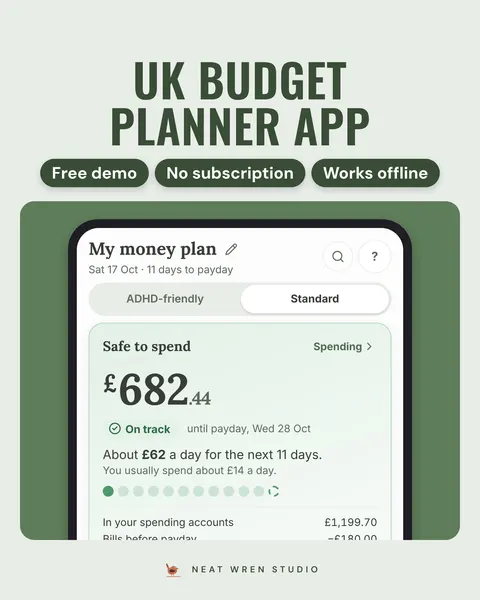
Plan around your pay
Calm Money: UK Budget App starts from the pay you receive and shows what's safe to spend until the next one.
Calm Money: UK Budget App · £12.59 on Etsy
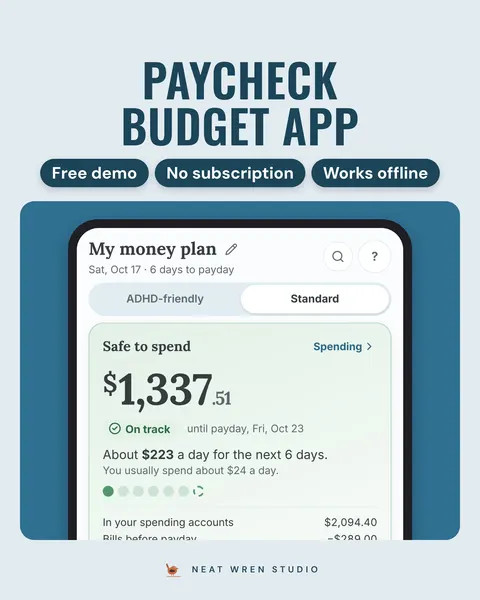
Plan around your pay
The Paycheck Budget App runs Safe to spend from one paycheck to the next, for weekly or every-two-weeks pay.
Paycheck Budget App · £12.59 on Etsy
Questions
Which tax codes does it handle?
Codes ending L, M, N or T, such as 1257L; K codes, such as K100, which never take more than half your pay; BR, D0 and D1, and D2 and D3 in Scotland; NT and 0T (there's no K0 or 0L); S (Scotland) or C (Wales) in front; and W1, M1 or X for the emergency, week 1 or month 1 basis.
Which National Insurance letter am I?
It's on your payslip. Most people are A. The rest are under More options, including the Freeport and Investment Zone letters. X means no National Insurance is due, as for someone under 16.
How do the pension types differ?
Relief at source comes out after tax and the scheme adds basic-rate relief: you pay £80, £100 goes in. Net pay comes out before tax. Salary sacrifice comes off your pay before tax and National Insurance. On qualifying earnings, only pay between £6,240 and £50,270 a year counts.
What about benefits and shares?
Payrolled benefits are taxed through your pay but not paid to you, with no employee National Insurance. Shares that vest are taxed and have National Insurance. If some were sold to cover it, that money is paid back through your pay, so the take-home matches your payslip.
Why is a bonus taxed so much?
With no pay period, it's worked out as if it came in your first payslip of the tax year. Fill in the pay period under Match my payslip to see it the way payroll does later in the year.
Where the figures come from
The rates in force, checked 23 October 2026:
- PAYE bands, the emergency code, National Insurance rates for each category letter, and student loan thresholds, 2026 to 2027
- Income Tax rates and the Personal Allowance taper over £100,000
- Scottish Income Tax rates and bands, 2026 to 2027
- Welsh Income Tax rates
- Tax codes, and the half-of-pay limit on K codes
- National Insurance category letters and rates
- Quarterly and yearly pay: which month's tables to use, in the Employer further guide to PAYE (CWG2)
- Student loan repayments: 9%, or 6% for a Postgraduate Loan, rounded down to the pound
- Student loan deductions in payroll: a pay period's threshold is the annual one over the periods in the year
- Workplace pensions: qualifying earnings, £6,240 to £50,270
- Pension tax relief: relief at source and net pay
Updated
Related calculators
Repaying a student loan? How each plan works, and what you'd repay in total.